bag making machinery
Bag making machinery encompasses a broad category of industrial equipment used to convert flat or tubular plastic film into finished bags, sacks, and pouches for diverse packaging applications. This machinery range includes not only the primary bag forming and sealing units but also auxiliary equipment such as unwind stands, tension controllers, printing stations, and stacking systems. Bag making machinery is essential for manufacturers who require high-volume, consistent output with minimal material waste, serving industries from retail and food to medical and industrial bulk packaging. The complexity of this machinery varies from simple manual-operated units to fully automated, servo-driven production lines capable of running 24/7 with minimal operator intervention.
The operational architecture of bag making machinery is built around a modular design that allows customization for specific bag styles and production speeds. At the heart of the system is the sealing and cutting module, which can be configured for bottom sealing, side sealing, or three-side sealing depending on the bag design. Modern bag making machinery incorporates PLC (Programmable Logic Controller) systems with touchscreen human-machine interfaces, enabling operators to adjust parameters like seal temperature, dwell time, cutting length, and production count with precision. Advanced models feature servo motors for each axis, ensuring accurate synchronization between film feeding, sealing bar movement, and cutting blade action. This digital control also facilitates recipe storage, allowing quick changeovers between different bag sizes and materials, which is crucial for contract packaging operations that handle multiple product lines.
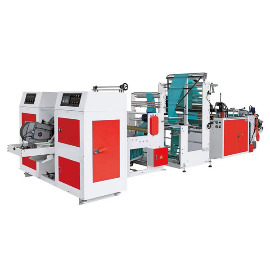
Plastic Bag Making Machine
Key technical specifications for bag making machinery include the maximum film width, which typically ranges from 300 mm to 1600 mm, and bag length adjustability from 50 mm to over 2000 mm. Production capacity is measured in cycles per minute or bags per minute, with standard bottom-seal machines reaching 250-300 bags per minute, while more complex T-shirt or vest bag machinery operates at 100-180 bags per minute. The sealing system can be impulse type (where the heating element cools quickly after each seal) or constant heat type (maintaining temperature throughout), with impulse preferred for thinner films to prevent overheating and burn-through. Film thickness compatibility ranges from 10 to 150 microns, with heavy-duty sack machinery handling up to 250 microns for industrial waste bags and construction sacks. Power consumption varies widely, from 5 kW for compact models to over 50 kW for high-speed production lines with integrated printing and drying units.
Different configurations of bag making machinery serve distinct market segments. The side-seal bag making machine is the simplest and most cost-effective, ideal for producing flat bags without gussets or handles, commonly used for bread bags, produce bags, and garment covers. Bottom-seal
bag making machinery produces bags with the seal at the bottom, offering better strength for heavier contents and often used for trash bags and retail merchandise. T-shirt bag making machinery adds handle punching and notching capabilities, making it a staple in supermarket and retail chains. Vest bag machinery incorporates gusset forming and die-cut handle features, resulting in a stronger bag with a flat bottom that stands upright on shelves. Zipper bag making machinery is the most sophisticated, requiring additional modules for zipper feeding, cutting, and sealing, along with precise alignment systems to ensure the zipper track is perfectly positioned along the bag opening.
Application areas for bag making machinery are extensive and growing with the expansion of e-commerce and food delivery services. In the retail sector, these machines produce millions of T-shirt and vest bags daily for grocery stores, clothing outlets, and department stores. The food industry relies on bag making machinery for packaging bread, pastries, frozen vegetables, snacks, and bulk grains, with strict hygiene standards requiring stainless steel contact parts and easy-clean designs. Medical and pharmaceutical applications demand specialized machinery with anti-static features and cleanroom compatibility to produce sterile pouches for surgical instruments and intravenous solutions. Industrial users require heavy-duty sack making machinery for cement bags, fertilizer sacks, animal feed packaging, and chemical drum liners, often featuring reinforced seals and high tear strength. The agricultural sector uses bag making equipment for fruit netting bags, silage bags, and tree wrapping bags, demonstrating the machinery's adaptability to both lightweight and heavy-duty tasks.
Selecting appropriate bag making machinery involves a holistic assessment of production goals, material types, and budget constraints. Firstly, identify the primary bag style and dimensions, as this determines the machine's sealing configuration, cutting method, and optional add-ons like gusset formers or handle punchers. Material compatibility is critical – while standard polyethylene and polypropylene run smoothly, specialty films like metallized films, co-extruded barriers, or biodegradable polymers may require modified sealing temperatures, adjusted tension settings, and specific guide roller materials to prevent slippage or sticking. Evaluate the required output volume; for high-volume continuous operations, servo-driven machinery with automatic splicing and fault detection is recommended to minimize downtime. Consider the available floor space and electrical infrastructure, as larger machines with multiple stations need substantial area and power supply. Finally, assess the manufacturer's reputation for spare parts availability, technical documentation, and on-site service response times, as these factors significantly affect long-term operational reliability and total cost of ownership.
Maintenance best practices for bag making machinery focus on preventive measures to avoid costly breakdowns and ensure consistent bag quality. Operators should perform daily visual inspections of sealing bars, cleaning them with brass scrapers to remove polymer deposits that can cause uneven seals. Weekly lubrication of all moving joints, chains, and cam followers using food-grade or high-temperature lubricants is essential to reduce friction and wear. Monthly verification of photo-eye sensors, temperature controllers, and pressure gauges ensures accurate registration and sealing force. Quarterly calibration of the cutting blade gap and sealing bar parallelism prevents ragged cuts and seal failures. Annually, a thorough inspection of gearboxes, belts, and bearings, along with replacement of worn components, should be scheduled during planned shutdown periods. Maintaining a detailed maintenance log helps track component life cycles and enables data-driven predictive maintenance, reducing unplanned downtime by up to 40% in many production environments.