bag manufacturing equipment
Bag manufacturing equipment encompasses the entire collection of machinery required to produce finished bags, starting from raw resin pellets through to the final packed product. This equipment chain includes film extrusion lines (blown film or cast film), printing units, bag making machines, and auxiliary systems such as winders, slitters, and conveyors. Unlike a standalone bag maker, bag manufacturing equipment refers to the integrated production line that allows a manufacturer to control every step from material formulation to bag conversion, ensuring consistent quality, reduced costs, and flexibility to produce a wide range of bag styles. Owning a complete set of bag manufacturing equipment is common among large-scale producers who supply bags to multiple industries, as it provides economies of scale and the ability to customise film properties for specific end-use requirements.
The bag manufacturing equipment line typically begins with the film extrusion stage, where raw plastic resin pellets (HDPE, LDPE, LLDPE, or masterbatch blends) are melted and formed into a continuous film. For blown film extrusion, the molten resin is forced through a circular die and inflated into a bubble, which is then cooled, collapsed, and wound into rolls. For cast film extrusion, the melt is extruded through a flat die onto a cooled roller, producing a thinner, more uniform film with superior optical clarity. The output from the extrusion line is the film roll that serves as the feedstock for the bag making machine. Many modern bag manufacturing equipment lines include in-line printing stations, either flexographic or gravure, that apply branding, barcodes, and usage instructions directly onto the film before winding, eliminating a separate printing step and reducing film handling. The extrusion process also allows the incorporation of additives such as UV stabilizers, anti-block agents, and biodegradable compounds, giving producers the ability to tailor the film to the bag's intended application.
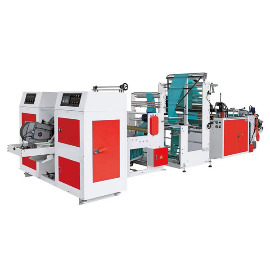
Plastic Bag Making Machine
Key components of bag manufacturing equipment beyond the bag maker itself include slitters, rewinders, and bag stacking systems. Slitters are used to trim the film edges and split wide rolls into narrower widths suitable for different bag sizes, increasing the production flexibility of the line. Automatic rewinders facilitate roll changeover without stopping the extrusion or printing process, ensuring continuous operation and reducing material waste. Bag stacking and counting systems are critical for labor-saving, as they automatically collect finished bags, count them into preset bundles, and transport them to a packing station via conveyor. Some advanced bag manufacturing equipment lines also incorporate a bag opening device and an automated packing module that places the counted bundles into cartons or poly bags for shipment, creating a fully automated, hands-off production environment from resin to shippable product.
Technical specifications of bag manufacturing equipment vary widely based on the production capacity and bag type. Extrusion output is measured in kilograms per hour, with typical lines producing 50-500 kg/hour for blown film and up to 1000 kg/hour for cast film. Film width can range from 300 mm to over 4000 mm, and thickness from 10 to 250 microns. The bag making section of the equipment line can process films at speeds of 100-300 cycles per minute, with the total line speed limited by the slowest module. Printing capabilities include up to 8 colors on flexographic presses, with registration accuracy within ±0.5 mm. Power consumption for a complete
bag manufacturing equipment line can be substantial, often exceeding 100 kW for extrusion and heating, so energy-efficient servo systems and insulated barrels are increasingly standard. The control system integrates all modules through a central PLC network, enabling synchronized operation, real-time monitoring of production metrics, and remote diagnostics for predictive maintenance.
Different configurations of bag manufacturing equipment are designed for specific market segments. The high-speed retail bag line is optimized for T-shirt and vest bags, featuring high-output extrusion, 4-color printing, and multiple bag making units running in parallel to maximize throughput. The heavy-duty sack line uses co-extrusion technology to produce multi-layer films with enhanced strength and barrier properties, coupled with robust bag making equipment that handles thick films and includes automatic valve insertion for filling. The biodegradable bag line incorporates specialized extruders with precise temperature controls to handle PLA and PBAT resins, along with bag making machines that have reduced sealing temperatures and gentler film handling to avoid degradation. The printed rollstock line produces pre-printed film rolls for external bag converters, focusing on high-print quality and precise registration rather than in-line bag making. Each configuration requires careful selection of extrusion and converting components to ensure harmony and efficiency, making engineering expertise critical when designing a bag manufacturing equipment plant.
Applications of bag manufacturing equipment serve the full spectrum of the packaging industry, from commodity retail bags to highly specialized medical and industrial films. Retail bag production dominates the market, with equipment lines producing billions of shopping bags annually for supermarkets, department stores, and fast-food chains. Food packaging applications require lines that can produce bags with excellent barrier properties for frozen foods, oxygen-sensitive snacks, and moisture-sensitive powders, often using multi-layer co-extrusion. Agricultural films and bags, including silage wrap and fruit protection bags, require equipment capable of UV stabilization and high tear strength, with wider extrusion dies and slower, more controlled bag making speeds. Medical and cleanroom applications demand pristine film surfaces and sterilizable materials, with bag manufacturing equipment featuring stainless steel contact surfaces and enclosed, HEPA-filtered environments. The e-commerce sector has spurred demand for poly mailer bag manufacturing equipment, integrating low-profile printing and perforation modules to produce lightweight, durable shipping envelopes that reduce shipping costs and material usage.
Selecting and integrating bag manufacturing equipment requires a strategic approach to capacity planning, layout design, and supplier selection. Begin by conducting a detailed market analysis to determine the bag types, volumes, and quality standards demanded by your target customers, as this defines the necessary capabilities of each equipment module. Evaluate the floor space and building infrastructure, including ceiling height for blown film towers, power supply capacity, and cooling water availability, as these often constrain equipment choices. When selecting extrusion, printing, and bag making components from different suppliers, ensure compatibility in terms of web width, line speed, and control protocols – preferably selecting a single supplier that can offer a turnkey solution to avoid integration issues. Consider the total cost of ownership over a 10-year horizon, factoring in purchase price, energy consumption, consumables like printing inks and sealing tapes, and maintenance costs, rather than focusing on initial capital expenditure alone. Finally, negotiate a comprehensive installation, training, and after-sales support package, as the complexity of integrated bag manufacturing equipment demands skilled operators and readily available spare parts to maintain high uptime and product quality throughout the equipment's lifecycle.
Operational excellence in a bag manufacturing equipment line relies on a robust maintenance strategy and continuous improvement culture. Establish a maintenance schedule that covers all modules, with daily inspections for film extrusion dies, printing anilox rolls, and sealing bars, focusing on cleaning and wear detection. Weekly checks on gearboxes, pumps, and cooling systems should include oil level verification and filter replacement. Monthly calibration of all sensors, pressure gauges, and temperature controllers ensures accuracy and consistency across the line. Implement a data logging system that captures production speed, waste percentages, and quality test results, enabling root cause analysis when defects occur. Invest in cross-training operators so they understand the interdependencies between extrusion, printing, and bag making, allowing them to proactively adjust parameters upstream when downstream issues are detected. By treating bag manufacturing equipment as an integrated ecosystem and applying systematic preventive and predictive maintenance, manufacturers can achieve overall equipment effectiveness (OEE) above 85%, driving profitability and competitive advantage in the dynamic flexible packaging market.