bag production line
A bag production line is an integrated sequence of machinery and auxiliary equipment designed to produce finished bags in a continuous, streamlined flow from raw material input to packaged final product. Unlike a single bag machine, a bag production line combines multiple operations – typically extrusion, printing, bag making, stacking, and packing – into a unified system that maximizes efficiency, reduces material handling, and ensures consistent quality across large production runs. Bag production lines are the foundation of modern plastic packaging factories, with capacities ranging from small-scale lines producing 500 bags per hour to mega-lines exceeding 10,000 bags per hour. The integration of all steps into one line minimizes work-in-process inventory, lowers labor costs, and enables rapid response to market demands, making it the preferred choice for established bag manufacturers and high-volume converters.
The structure of a bag production line follows a logical progression from upstream material preparation to downstream bag finishing. The first station is the raw material blending and feeding system, where resin pellets, masterbatches, and additives are pneumatically conveyed to the extruder hopper in precise ratios. Next, the extrusion module (blown or cast) melts the blend and forms a continuous film, which passes through a cooling section to solidify the film structure. After cooling, the film is guided to a printing station (optional but common) where flexographic or rotogravure units apply graphics and text. The printed film then enters the bag making module, which may consist of multiple bag machines operating in parallel to increase output. Following bag making, a stacking and counting station collates bags into predetermined bundle sizes, and a packaging module shrink-wraps or cartons the bundles for shipment. All stations are synchronized by a central control system that monitors line speed, tension, and quality metrics, with automatic adjustments to compensate for variations in film properties or environmental conditions.
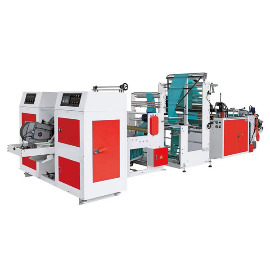
Plastic Bag Making Machine
Key technical parameters for a bag production line focus on the overall system performance rather than individual machines. Total line speed is determined by the slowest module, typically the bag making section, so optimizing the bag machine speed is critical for maximizing throughput. The production line's overall width capability is limited by the extrusion die width and the bag machine's maximum web width, with common configurations handling up to 1200 mm. Material usage efficiency, or yield, is calculated as the ratio of finished bag weight to raw resin weight, with well-tuned lines achieving over 95% yield through edge-trim recycling and accurate registration. Energy efficiency of the entire line is influenced by the extruder's specific energy consumption, the heating requirements of the sealing bars, and the auxiliary cooling and compressed air systems, with modern designs incorporating heat recovery from the extruder to preheat drying air or feed water. Changeover time between different bag sizes or designs is a critical productivity factor, with advanced lines featuring quick-change tooling and recipe-based settings to reduce changeover from hours to minutes.
Different
bag production line configurations cater to specific product categories and market demands. The high-speed T-shirt bag production line is one of the most common, featuring a high-output blown film extruder, a multi-color flexographic press, and multiple T-shirt bag machines operating in parallel, often with automatic stacking and packaging systems that deliver ready-to-ship cartons. The heavy-duty sack production line uses a co-extrusion blow line to create laminated or multi-layer films, followed by a sack making machine with reinforced sealing bars and an automatic valve insertion module, designed for 25-50 kg bags for cement, feed, and chemicals. The zipper bag production line adds a specialized zipper applicator between the printing and bag making stations, with additional cooling and alignment systems to ensure the zipper track is securely fused to the film. The biodegradable bag production line incorporates extruders with enhanced mixing sections and cooling systems to process temperature-sensitive biopolymers, along with bag making machines that use lower sealing temperatures and gentler film handling to prevent degradation.
Applications of bag production lines are widespread across all packaging-intensive industries. The retail sector relies on high-speed T-shirt and vest bag lines to supply supermarkets and shopping centers, with production volumes often exceeding millions of bags per week to meet daily consumer demand. The food industry uses dedicated bag production lines for bread bags, frozen vegetable pouches, and snack packaging, requiring strict adherence to food safety regulations and often including in-line metal detection and checkweighing. The building materials sector operates heavy-duty sack lines for cement, mortar, and plaster, where bag strength and seal integrity are paramount to prevent dust emissions and product loss. The agricultural industry uses bag production lines for fertilizer, seed, and animal feed packaging, often with UV stabilizers and anti-static properties added during extrusion. The medical and pharmaceutical sectors demand cleanroom-compatible bag production lines for sterile packaging, where the entire line is enclosed, and HEPA filters maintain particulate cleanliness.
Optimizing a bag production line involves careful balance of speed, quality, and changeover flexibility. Begin by mapping the entire material flow from silos to finished goods, identifying bottlenecks such as unwinding stations that limit line speed or stacking units that cannot keep up with the bag maker. Implement a centralized lubrication system to reduce manual maintenance and extend bearing life across all modules. Use high-quality temperature controllers with PID tuning to maintain sealing temperatures within ±1°C, ensuring consistent seal strength even at varying line speeds. Install vision inspection systems at critical points – such as after printing and after sealing – to automatically detect defects and trigger alarms or divert bad bags, reducing manual inspection costs. Train operators in total productive maintenance (TPM) principles, encouraging them to perform routine cleaning and small adjustments on their shift to prevent minor issues from escalating into major breakdowns. By continuously monitoring key performance indicators like line uptime, scrap rate, and bundles per man-hour, plant managers can identify improvement opportunities and implement corrective actions that boost overall line efficiency and profitability.
Maintenance of a bag production line requires a coordinated approach due to the interdependence of its modules. Establish a master maintenance schedule that accounts for the differing service intervals of extruders, printing units, and bag making machines, and plan shutdowns during low-demand periods to minimize production loss. For the extruder, regular screw and barrel wear checks are essential, as worn components reduce mixing quality and increase melt temperature. Printing units require daily cleaning of anilox rollers and doctor blades to prevent ink buildup and ensure consistent color density. Bag making machines need weekly calibration of sealing bars and photo-eye sensors, with periodic replacement of heating elements and thermocouples. Stock critical spare parts for all modules, especially consumables like sealing belts, heater bands, and sensor cables, to ensure rapid repair in case of failure. Maintain detailed records of all maintenance activities, repairs, and component replacements, as this data supports predictive maintenance algorithms that can forecast failures based on run hours or cycles, enabling proactive intervention and maximizing the uptime of the entire bag production line.