flat bag making machine
A flat bag making machine is the most basic and widely used type of bag production equipment, producing simple flat bags without handles, gussets, or zippers. These bags are characterized by a single bottom seal (or side seal) and an open top, making them ideal for a vast range of applications including produce, bakery items, hardware parts, garment covers, and general merchandise. Flat bag making machines are the entry-level choice for many converters due to their relatively low cost, simple operation, and high speed – often achieving 250-300 bags per minute for thin films. They are available in both bottom-seal and side-seal configurations, with bottom-seal being more common for most applications. The machine's straightforward design includes an unwind stand, sealing bars, cutting knife, and stacking conveyor, with minimal optional add-ons, making them reliable and easy to maintain.
The working principle of a flat bag making machine is straightforward: the film is unwound from a roll, passed through tension control and guide rollers, then fed into the sealing station where a heated bar creates the bottom seal (or side seal, depending on the machine). The sealing bar clamps down for a preset dwell time, then releases. The sealed film advances to the cutting station where a rotary or guillotine knife cuts the bag to length. The cut bags are then transported via a conveyor to a stacking table where they are counted and manually or automatically packed. For printed flat bags, a registration camera is placed before the sealing station to ensure the seal and cut align with the print marks. Some flat bag machines include a perforation unit to create easy-tear lines for roll-type bags (e.g., produce bags on a roll). The simplicity of the process allows high speeds and low defect rates, making flat bag machines a workhorse in the packaging industry.
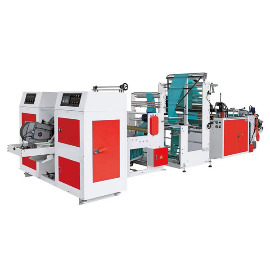
Plastic Bag Making Machine
Key technical specifications for flat bag making machines include bag width (100-1200 mm), bag length (100-2000 mm), film thickness (10-150 microns), and production speed (150-300 BPM for bottom-seal, slightly lower for side-seal). The sealing temperature range is 100-200°C, with heating power typically 5-15 kW. The machine operates on standard 380V 3-phase power and requires compressed air at 6 bar for pneumatic actuators. The cutting mechanism can be rotary (for continuous high speed) or guillotine (for heavier films). The stacking unit usually holds up to 500 bags, with an automatic counter. Optional features include a back-seal device for producing bags from folded film, a punched hole for hanging, and an electrostatic eliminator to prevent bag sticking. The machine's footprint is relatively compact (3-5 meters long), making it suitable for small to medium-sized factories.
flat bag making machines are used in an enormous variety of sectors. In the food industry, they produce bags for fresh produce (apples, potatoes, onions), bread and pastries, confectionery, and dry goods like rice and beans. Retail stores use flat bags for merchandise such as clothing, books, and toys. Industrial applications include packaging of small parts, screws, hardware, and dust covers for machinery. The medical field uses flat bags for disposable gloves, syringes, and sterile wraps. The agricultural sector utilizes flat bags for seed packaging and flower sleeves. The versatility of flat bags extends to household uses as trash can liners and general storage bags. With the increasing demand for sustainable packaging, flat bag machines are being adapted to process biodegradable films and recycled content, often with modified temperature settings and tension controls to accommodate the different melt characteristics of these materials.
Selecting a flat bag making machine depends on your bag size, film type, and required output. For standard produce bags (200-300 mm wide), a bottom-seal machine with 250 BPM is adequate. If you produce bags from folded film (i.e., tubing without a side seal), you need a machine with a back-seal option that seals the film's open side. For high volumes, servo-driven machines offer faster speed and better consistency; however, for small batches, a clutch-brake machine may be cost-effective. Consider the stacking method – if you need high stacks with accurate counts, choose a machine with a servo-driven conveyor and a counter with preset bundle discharge. For perforated roll bags, ensure the machine has a perforation unit that can be adjusted for different tear strengths. Also, evaluate the changeover time; flat bag machines generally have quick changeover (under 10 minutes) for different bag lengths, making them flexible for short runs. Check the machine's build quality – heavy-duty frames reduce vibration at high speeds, improving cut accuracy.
Maintenance of a flat bag making machine is relatively simple compared to other bag types. Daily tasks include cleaning the sealing bars with a brass brush to remove polymer residue, wiping the guide rollers, and checking the film tension. Weekly, lubricate the bearings of the conveyor and cutting mechanism, and inspect the heating elements for signs of oxidation. Monthly, calibrate the temperature controllers and pressure gauges, and check the blade sharpness on the cutting knife. For machines with registration, clean the photoelectric sensor lens regularly to ensure accurate mark detection. The cutting blade typically lasts 5-10 million cuts; replace it when you notice jagged edges or incomplete cuts. Keep a log of seal quality and speed settings for each film type to facilitate quick setups. Because flat bag machines have fewer moving parts, uptime is generally high – often exceeding 95%. By following a routine maintenance schedule, operators can ensure consistent bag quality and extend the machine's service life, making the flat bag making machine a reliable and profitable asset for any packaging business.