garbage bag making machine
A garbage bag making machine is a specialized bag production system designed to manufacture large quantities of plastic bags used for waste collection, typically sold on perforated rolls or as individual flat packs. These machines are optimized for high-speed production of simple bottom-seal bags, often with coreless winding and perforation features that allow users to tear off individual bags from a roll. Garbage bags are produced in a wide range of sizes, from small kitchen trash bags (20-40 liters) to large industrial bin liners (100-300 liters) and construction debris bags. The machines prioritize speed, durability, and low cost per bag, with many achieving 150-250 bags per minute, and some high-end servo models reaching 300 bags per minute. They are widely used by converters supplying retail stores, janitorial services, municipalities, and industrial plants.
The production process on a garbage bag making machine begins with film unwinding from a large roll, similar to other bottom-seal machines. The film is then passed through a sealing station where a bottom seal is applied using heated bars. After sealing, the film advances to a perforation unit that creates a line of small punctures across the film, allowing easy tearing. The perforation is typically made using a serrated blade or a laser (for higher precision). The film then proceeds to a winding station, where the continuous stream of sealed and perforated bags is wound onto a coreless spindle to form a roll of bags. The roll is automatically cut to the desired length (e.g., 20-50 bags per roll) and then ejected onto a conveyor. Some machines are designed to produce flat-packed garbage bags without perforation, using a stacking conveyor instead of a winder. The entire process is controlled by a PLC that synchronizes the film feed, sealing, perforating, and winding speeds.
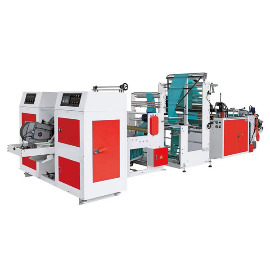
Plastic Bag Making Machine
Key technical specifications for garbage bag making machines include bag width (200-1200 mm), bag length (400-2000 mm), film thickness (10-50 microns for thin kitchen bags, up to 150 microns for heavy-duty), production speed (150-300 BPM for bottom-seal, slightly lower for coreless winding). The perforation unit is a critical component, with adjustable tear strength (typically 80-120% of film tensile strength). The winding station can handle roll diameters up to 600 mm, with coreless winding being a common feature to reduce material cost. Sealing temperature ranges from 120-200°C. The machine's power consumption is 15-40 kW, and compressed air requirement is 6 bar. The stacking or winding section must be capable of high-speed operation without jamming. Optional features include an automatic roll changer for non-stop operation, a color printing unit for branding, and a static eliminator to prevent bags from sticking on the roll.
garbage bag making machines are used in the waste management and janitorial supply industries. Residential trash bags for kitchens and bathrooms are produced in large volumes on these machines, often with added fragrances or drawstring features. Commercial and industrial uses include large bin liners for offices, hospitals, and hotels. Construction and demolition debris bags are made from thicker films with reinforced seals. Municipalities use garbage bag machines to produce bags for leaf collection and curbside waste. The machine's ability to produce perforated rolls is especially valuable for janitorial services, as it simplifies bag dispensing. With the global push for sustainable waste management, many garbage bag machines are now adapted to process biodegradable and compostable films, as well as post-consumer recycled content, though these materials often require lower temperatures and slower speeds to prevent tearing.
Selecting a garbage bag making machine requires careful consideration of the roll or flat-pack format, bag size, and film material. For perforated roll production, prioritize the winding unit's reliability – machines with servo-controlled winding tension produce more consistent rolls without wrinkles or loose bags. If you produce heavy-duty bags (over 100 microns), ensure the sealing bars have sufficient heating power and the cutting mechanism is robust. For flat-packed garbage bags, a machine with a high-speed stacking conveyor and a compression unit is needed to keep stacks neat. Consider the film type – recycled PE often has variable melt properties, so choose a machine with wide temperature adjustment and advanced PID control. Production speed is important, but also assess the changeover time for different bag lengths and roll counts. Some machines offer quick-change perforation blades and sealing bars to reduce downtime. Also, evaluate the machine's energy efficiency, as garbage bag production often runs 24/7, and energy costs are significant.
Maintenance of a garbage bag making machine centers on the perforation and winding units. The perforation blade must be kept sharp to ensure clean tear lines; inspect it daily and replace it when it becomes dull (typically after 5-10 million cycles). The winding station's rollers and guides require regular cleaning to prevent residue buildup that can cause bag misalignment. Lubricate the winding spindle bearings weekly, as they operate under high speed. The sealing bars, as with other bottom-seal machines, need daily cleaning to prevent carbon buildup. Check the tension sensors monthly to ensure consistent film tension, especially when switching film suppliers. For coreless winding, the cut-off knife that separates rolls must be sharp and properly timed; calibrate it weekly. Keep a stock of perforation blades and winding tubes (if used) to minimize downtime. Because garbage bag machines often run at high speeds for extended periods, implement a predictive maintenance program that monitors motor currents and bearing temperatures to detect early signs of wear, preventing unexpected stoppages that can disrupt supply to waste management customers.