high speed bag making machine
A high speed bag making machine is engineered to operate at significantly faster production rates than standard models, typically achieving 200 to over 300 cycles per minute for simple bag configurations. These machines are the cornerstone of large-scale bag manufacturing operations, where meeting high-volume orders with consistent quality is essential for profitability. High speed bag making machines incorporate advanced servo motor drives, lightweight moving components, and optimized thermal management to reduce cycle times while maintaining seal integrity and cut accuracy. They are commonly used for producing T-shirt bags, vest bags, flat bags, and garbage bags for retail, food, and waste management industries, where production runs often exceed millions of bags per day.
The core design of a high speed bag making machine focuses on minimizing inertia and maximizing synchronization between the film feed, sealing, and cutting stations. Servo motors replace traditional clutch-brake systems, providing faster acceleration and deceleration, precise position control, and reduced mechanical wear. The sealing bars are often made of lightweight alloys with rapid heating and cooling capabilities, allowing short dwell times of 0.1-0.3 seconds without compromising seal strength. The cutting mechanism uses a rotary knife with a servo-controlled timing that matches the bag length, eliminating the need for mechanical cams and enabling quick size changes. Advanced tension control systems, including dancer arms with load cell feedback, maintain constant film tension even during acceleration and deceleration, preventing film stretching or wrinkling that can cause misregistration. The machine's frame is constructed from heavy-duty steel with vibration-damping mounts to ensure stability at high speeds, while the control panel features a high-response PLC with predictive algorithms that anticipate and compensate for variations in film properties.
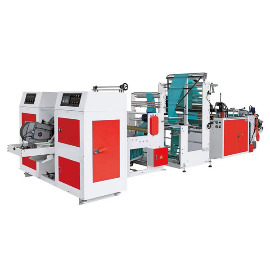
Plastic Bag Making Machine
Key performance parameters of high speed bag making machines include maximum cycle rate, bag length accuracy, and seal strength consistency. Top-end models can achieve 300 cycles per minute for bottom-seal flat bags, with cycle rates dropping to 180-220 for T-shirt or vest bags due to the additional punching and folding operations. Bag length accuracy is maintained within ±0.5 mm through closed-loop encoder feedback, ensuring uniform bag dimensions. Seal strength is monitored continuously via infrared sensors that measure seal temperature and pressure profiles, with automatic adjustments to maintain a Cpk of 1.33 or higher. The machine's maximum film width typically ranges from 300 mm to 1200 mm, with thickness handling from 10 to 150 microns. Energy consumption per thousand bags is notably lower than older models, thanks to regenerative braking in servo drives and insulated sealing bars that reduce heat loss. Noise levels are also reduced to below 75 dB through sound-dampening enclosures and balanced rotating parts, improving operator comfort and safety.
Several innovative features distinguish
high speed bag making machines from standard versions. Automatic splice detection and splicing systems allow continuous operation when the film roll nears the end, reducing downtime for roll changes. Print registration uses high-speed CCD cameras that can detect registration marks at speeds up to 300 cycles/min with a response time under 10 milliseconds, ensuring accurate cutting and sealing of printed bags. The stacking unit is designed with a high-speed reciprocating conveyor that lays bags flat in a neat stack, with an air blast system that separates each bag to prevent sticking. Some models include an in-line leak tester that applies a small vacuum to each bag to detect pinholes or weak seals, automatically rejecting defective units. Remote diagnostics and IoT connectivity allow production managers to monitor machine performance in real-time from a central control room, and predictive maintenance algorithms alert operators when components like heaters or bearings are approaching end-of-life, minimizing unplanned downtime.
Applications of high speed bag making machines are concentrated in high-volume production environments where speed translates directly to cost savings. Supermarket and retail bag converters rely on these machines to produce T-shirt and vest bags that are distributed to thousands of stores, with production runs often exceeding 500,000 bags per shift. Garbage bag manufacturers use high speed machines to produce perforated rolls for residential and commercial use, requiring consistent perforation strength and easy tear-off. Food service packaging companies run high speed machines for produce bags, bakery bags, and fast-food wrappers, where speed and hygiene are equally important. Industrial packaging producers employ high speed equipment for making poly mailer bags for e-commerce shipping, where light weight and durability are key. The medical sector uses high speed bag making machines for sterile packaging components, although with stricter validation and cleanroom conditions, but still benefiting from the speed and precision offered by modern designs.
Optimizing a high speed bag making machine requires careful setup and ongoing monitoring to maintain peak performance. The film roll must be centered and tensioned correctly; use a tension gauge to set the dancer arm at the optimal position for each film thickness. Sealing temperature should be set based on the film manufacturer's recommendation, then fine-tuned by running test batches and checking seal strength with a peel tester. Adjust the sealing pressure to ensure the jaws close completely but without crushing the film; pressure typically ranges from 3 to 6 bar. For print-registered bags, ensure the photo-eye sensor is clean and properly aligned, and set the registration gain to avoid over-correction. Monitor production speed against the rated speed and gradually increase it while checking for signs of film slippage or misalignment – if wrinkles appear, reduce speed and check film guiding. Keep detailed records of settings for each film type and bag style, as this enables rapid changeovers and reduces set-up time by up to 50%. Regularly inspect the cooling systems for sealing bars and servo motors to prevent overheating, especially during summer months or high ambient temperatures.
Maintenance of a high speed bag making machine is more demanding due to the higher stresses and faster cycles. Establish a daily checklist that includes cleaning sealing bars with a soft brass brush, checking oil levels in the gearboxes, and inspecting the drive belts for wear. Weekly, lubricate all bearings and cam followers with high-speed grease, and check the servo motor couplings for any play. Monthly, calibrate the temperature controllers and pressure transducers using certified instruments, and verify the blade gap on the rotary cutter. Quarterly, replace the sealing bar heating elements and thermocouples as a preventive measure, even if they appear functional, as their performance degrades gradually. Annually, perform a full mechanical overhaul, including bearing replacement, gearbox oil change, and alignment checks on all shafts. Training operators on proper shutdown and startup procedures reduces thermal shock to the heating elements. By implementing a rigorous preventive maintenance schedule, a high speed bag making machine can achieve an uptime of 95% or higher, ensuring that the investment delivers the expected return through sustained high-volume production.