servo motor bag making machine
A servo motor bag making machine is a modern evolution of traditional bag making equipment, replacing mechanical clutch-brake and cam systems with high-performance servo motors for each motion axis. This design offers unprecedented precision, speed control, and energy efficiency, making servo motor bag making machines the preferred choice for manufacturers demanding top-tier accuracy and reduced operational costs. Servo motors provide closed-loop feedback, allowing the machine to instantly correct any deviations in position, speed, or torque, resulting in consistent bag dimensions, registration accuracy, and seal quality even at high speeds. They are available for all bag types, from simple flat bags to complex stand-up pouches, and are particularly valuable for printed bags where registration tolerances are tight.
The fundamental advantage of a servo motor bag making machine lies in its independent axis control. In a traditional machine, a single main motor drives all movements through gears and cams, meaning adjustments to one parameter affect others. With servo motors, the film feed, sealing bar motion, cutting blade position, and stacking conveyor can all be programmed independently and synchronized via the PLC. This decoupling allows operators to change bag length or speed without mechanical reconfiguration, simply by entering new values on the touchscreen. The servo system also enables dynamic acceleration and deceleration profiles, reducing mechanical shock and vibration, which extends the life of mechanical components and reduces noise. Furthermore, servo motors consume electricity only when moving and use regenerative braking to recover energy during deceleration, achieving energy savings of 30-50% compared to traditional motor-and-clutch systems.
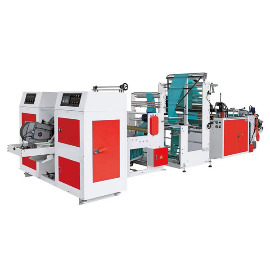
Plastic Bag Making Machine
Key technical specifications for servo motor bag making machines include torque rating, response time, and position accuracy. Servo motors used in bag machines typically have torque ratings from 5 Nm to 50 Nm, with peak torque up to three times the rated value for rapid acceleration. Response time, defined as the time from receiving a command to achieving the target position, is under 1 millisecond for high-end models, ensuring real-time synchronization. Position accuracy is within ±0.01 mm through encoder resolution of 20 bits or higher, guaranteeing consistent bag length and seal placement. The servo drive system is paired with a PLC that has high-speed counters and dedicated motion control algorithms, enabling coordinated multi-axis movements. Many machines also feature a second encoder on the film roller for direct measurement, eliminating errors from belt slip or gear backlash. The control panel typically includes a graphical user interface that displays all axis status, allows manual jogging, and provides diagnostic information for each servo drive.
Specific design features of servo motor bag making machines enhance both performance and user experience. The sealing bars, actuated by servo motors rather than pneumatic cylinders, can be programmed with adjustable pressure profiles – soft contact at the beginning to avoid film shock, then increased pressure for sealing, and rapid release to minimize dwell time. This technology enables sealing speeds up to 300 cycles per minute without compromising seal strength. The cutting mechanism, often a rotary knife driven by a servo motor, can be dynamically phase-shifted to adjust cut position in real-time based on registration feedback, achieving accuracy of ±0.5 mm even with film slippage. The film feed rollers are also servo-driven with tension feedback from load cells, maintaining constant tension irrespective of roll diameter changes, eliminating stretching and wrinkling. Automated lubrication systems are integrated with the servo control, applying grease to bearings at programmed intervals to reduce maintenance workload. Additionally, the machine's quiet operation (below 70 dB) improves the working environment compared to noisy pneumatic or cam-driven machines.
Applications of
servo motor bag making machines are found in industries where precision and speed must coexist. In the production of high-quality printed retail bags, servo machines ensure that the print registration remains accurate even at maximum speed, eliminating misprinted bags and reducing waste. For zipper bags, the precise control of servo motors allows accurate alignment of the zipper track with the seal line, preventing zipper skew that would render the bag unusable. In medical packaging, the repeatable accuracy of servo machines is essential to meet ISO 11607 validation requirements, as seal position and strength must be within tight tolerances. For e-commerce poly mailers, the high speed and consistent bag length provided by servo machines improve downstream packing efficiency by ensuring uniform bag sizes for automated filling lines. Many converters also appreciate the quick changeover capability – a servo bag making machine can switch between bag sizes in under three minutes by recalling a recipe, making it ideal for contract packaging operations with frequent order changes.
Selecting a servo motor bag making machine involves evaluating the required precision, speed, and the total cost of ownership. First, assess the tolerance needed for your bag length and print registration; if your application demands ±0.5 mm or tighter, a servo machine is almost mandatory. Determine your target production speed; servo machines typically offer higher speeds than equivalent pneumatic machines, but you should verify that the servo system can deliver that speed with your film type, as heavier films may require higher torque motors. Compare energy consumption figures from different suppliers, as this directly affects operating costs; request independent energy audit reports. Evaluate the control software's user-friendliness – a well-designed HMI reduces operator training time and errors. Consider the supplier's ability to provide remote support and firmware updates, as servo controllers often benefit from periodic software improvements. Finally, factor in the longer lifespan of servo motors (typically 20,000+ hours) and reduced spare parts inventory, as servo systems have fewer wear components than mechanical clutches and brakes, ultimately offering a lower total cost of ownership over a 5-10 year period.
Maintenance of a servo motor bag making machine is less intensive than traditional machines, but requires attention to electronic and cooling components. Daily, clean the servo motors and drives of dust using compressed air, and check the cooling fans for proper operation. Weekly, verify that all cable connections are tight and that the encoder cables are free from damage. Monthly, use the drive's diagnostic software to review error logs and identify any recurring warnings; recalibrate the tension sensor and registration sensor. Annually, replace the backup battery on the absolute encoder (if equipped) to prevent loss of position data on power loss, and clean the heat sinks of the servo amplifiers. It is crucial to use only factory-authorized service parts for servo motors, as incorrect replacements can damage the drive electronics. Maintain a spare set of common servo motors and drives for critical machines to minimize downtime in case of failure. By following these practices, a servo motor bag making machine can achieve over 98% uptime and provide consistent, high-precision output for many years, making it a sound investment for quality-conscious bag manufacturers.