square bottom bag making machine
A square bottom bag making machine is specialized equipment designed to produce bags with a flat, square-shaped bottom that allows the bag to stand upright and maintain a stable base even when filled with heavy or bulky products. These bags are distinct from stand-up pouches in that the bottom is typically formed by folding and sealing multiple panels, creating a rigid rectangular base. Square bottom bags are widely used for coffee, pet food, flour, sugar, and other granular or powdered products that require a stable, space-efficient package for shelf display and storage. The machine is more complex than standard flat bag makers, incorporating bottom forming, folding, and sealing stations that create the characteristic flat bottom. Production speeds are moderate, typically 40-80 bags per minute, due to the multiple forming steps involved.
The operational sequence of a square bottom bag making machine starts with film unwinding and tension control. The film is then guided through a series of folding stations that create the square bottom shape. This typically involves making longitudinal folds that will become the bottom panels, followed by transverse folds to form the base. The film then enters a sealing station where the bottom panels are fused together using heated bars that apply heat and pressure to create a strong, flat bottom seal. Next, the side seals are applied to the bag body, and finally, the top edge is sealed or left open, depending on the bag design. A cutting station separates individual bags. For printed films, registration sensors ensure the bottom folds align with the graphics. Some machines include a gusset forming section before the bottom folding to create side gussets that complement the square bottom. The finished bags are stacked on a conveyor, with the flat bottom allowing stable stacking.
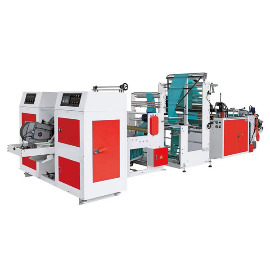
Plastic Bag Making Machine
Key technical specifications for square bottom bag making machines include bag width (150-600 mm), bag height (200-800 mm), bottom width (50-200 mm), film thickness (30-200 microns), and production speed (40-80 BPM). Sealing temperature ranges from 140-240°C, with separate zones for bottom and side seals. Sealing pressure is higher than standard machines, often up to 12 bar, to ensure the multiple layers in the bottom are fully fused. The machine's power consumption is typically 25-50 kW, with compressed air at 6-8 bar. The forming station requires precise mechanical adjustments for different bottom sizes. The cutting system is usually a guillotine type for clean cuts on thick films. Optional features include an automatic bottom former size changeover, in-line leak testing, and a date coder. The stacking unit often includes a compression device to flatten the square bottom for neat stacking.
square bottom bag making machines are primarily used in the food packaging sector for coffee, tea, spices, flour, and sugar, where a stable base enhances shelf appeal and prevents product spillage. Pet food brands use square bottom bags for premium treats and kibble, as the flat bottom allows easy stacking on pallets. Chemical and agricultural industries use them for fertilizers, seed, and powdered additives, where the bag must stand upright during filling and transport. Industrial applications include packaging of small hardware parts and powders. The retail sector uses square bottom bags for gift items and promotional packaging. With the shift towards recyclable paper-based packaging, some square bottom bag machines are now adapted to handle kraft paper with PE coating, requiring modifications to the sealing system (hot air or ultrasonic sealing instead of direct heat).
Selecting a square bottom bag making machine requires careful evaluation of the bottom size and the film material's rigidity. The bottom width must be matched to the product volume and display requirements; a wider bottom offers more stability but uses more film. The machine's folding mechanism must be adjustable to accommodate different bottom sizes, so look for quick-change forming parts. The sealing system must be powerful enough to seal multiple layers (often 4-6 layers at the bottom corners) without causing burn-through. For high-barrier films (metallized or foil laminates), ensure the machine has a cooling station immediately after sealing to prevent distortion. Production speed is inherently lower; if you need higher throughput, consider a double-lane machine. Evaluate the changeover time between different bag sizes, as square bottom machines have more mechanical adjustments than simpler bag makers. Also, check the machine's ability to handle recycled or biodegradable films, which may have different folding and sealing properties.
Maintenance of a square bottom bag making machine is intensive due to the complex folding and sealing sections. The folding plates and forming bars must be kept perfectly clean and smooth; any scratches or residue can cause film wrinkles and mis-folds. Clean these parts daily with a soft cloth and isopropyl alcohol. The bottom sealing bars, which often have a stepped profile to match the bottom shape, require careful cleaning to remove polymer buildup from the crevices. Lubricate all moving folding components weekly, as they operate under high friction. Check the alignment of the folding stations monthly – misalignment causes asymmetrical bottoms. The sealing pressure should be calibrated using a pressure gauge every month, as uneven pressure leads to weak seals at the bottom corners. The cutting blade for guillotine cutters must be sharpened regularly to prevent ragged edges, which are more noticeable on square bottom bags. Keep a stock of spare folding plates and sealing bars for different sizes. Because the machine has many moving parts, a comprehensive preventive maintenance schedule with daily, weekly, and monthly tasks is essential to maintain the precision required for square bottom bags and to avoid costly downtime.