stand-up pouch bag making machine
A stand-up pouch bag making machine is a sophisticated piece of bag production equipment designed to manufacture pouches with a bottom gusset that allows the bag to stand upright on its own when filled. These pouches, often called Doypacks, are premium packaging solutions used for coffee, snacks, liquid soaps, pet food, and many other consumer products. The stand-up feature provides excellent shelf presence, convenience, and product protection. The machine is more complex than standard flat bag machines, requiring additional forming stations to create the bottom gusset and often multi-layer sealing for barrier properties. Speeds for stand-up pouch machines are typically 60-120 bags per minute, as the bottom gusset formation and sealing require more time. They are available in both pre-made pouch lines and form-fill-seal configurations, with the former being more common for high-quality printed pouches.
The production process on a stand-up pouch bag making machine begins with film unwinding from one or more rolls, as stand-up pouches often use multi-layer laminates (e.g., PET/AL/PE) for barrier. The film passes through a printing station (if not pre-printed) and then enters the forming section, where a bottom gusset is created by folding the film inward at the bottom edge. This is achieved using specially shaped folding boards and heated forming bars that set the crease. After gusset formation, the film proceeds to the sealing station, where bottom seals are applied to the gusset area, followed by side seals. The side seals may be made with a flat sealing bar or a shaped seal to match the pouch contour. Finally, a cutting station separates individual pouches, and a stacking unit collects them. Some machines include a zipper applicator for reclosable stand-up pouches, adding another layer of complexity. Throughout the process, precise registration ensures that the graphics align correctly with the gusset and seals.
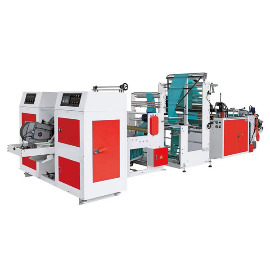
Plastic Bag Making Machine
Key technical specifications for stand-up pouch bag making machines include pouch width (100-400 mm), pouch height (150-600 mm), gusset depth (30-100 mm), film thickness (30-200 microns), and production speed (60-120 BPM). Sealing temperature ranges from 130-250°C, with separate zones for bottom, side, and gusset seals. The sealing pressure is higher than standard machines, often up to 10 bar, to ensure the multiple layers are fully fused. The machine requires robust construction with heavy-duty frames to withstand the forces of gusset forming. Power consumption is typically 30-60 kW, and compressed air demand is 6-8 bar at 800-1200 L/min. The cutting station often uses a rotary shear with a servo-driven synchronization. Optional features include an automatic gusset width adjustment, an in-line leak tester, and a date coder. The stacking unit must handle the three-dimensional shape of stand-up pouches, often using a tucking mechanism to flatten the gusset for stacking.
stand-up pouch bag making machines are heavily used in the food and beverage industry for premium products. Coffee roasters use them for whole bean and ground coffee, as the stand-up pouch provides an excellent gas barrier and attractive presentation. Snack brands use them for nuts, dried fruits, and trail mixes. Liquid products like soaps, shampoos, and edible oils are also packaged in stand-up pouches due to their stability and ease of pouring. Pet food manufacturers use them for premium treats and small-batch foods. The pharmaceutical sector uses stand-up pouches for nutritional supplements and medical liquids. With the rise of e-commerce, stand-up pouches are also used for shipping non-fragile goods, as their shape provides some cushioning. The trend toward sustainable packaging has led to machines capable of processing mono-material PE structures that are recyclable, though these materials require careful sealing parameter adjustments to maintain gusset integrity.
Selecting a stand-up pouch bag making machine involves assessing the gusset depth and seal strength requirements. The gusset depth directly affects the pouch's stability – deeper gussets allow larger volumes but require more film and stronger seals. Choose a machine with adjustable gusset forming plates to accommodate different pouch sizes. The sealing system must be capable of handling multi-layer films, which often have uneven thickness at the gusset area; look for machines with servo-controlled pressure that can adapt to film variations. Production speed is typically limited by the gusset forming process; if you need higher output, consider a machine with multiple lanes or a twin-head gusset former. For printed pouches, ensure the registration system has high-speed camera capabilities (200+ Hz) to maintain accuracy at the machine's top speed. Also, evaluate the changeover time – quick-change gusset formers and sealing bars reduce downtime significantly. The machine's footprint is larger than standard bag makers, so plan floor space accordingly.
Maintenance of a stand-up pouch bag making machine is more demanding due to the gusset forming section. The gusset folding plates must be kept clean and scratch-free; inspect them daily and polish them if needed. The gusset sealing bars, which often have complex shapes, require careful cleaning to prevent residue buildup that can distort the gusset shape. Lubricate the gusset former's moving parts weekly, as they experience high friction. The main sealing bars should be cleaned every shift, and their alignment checked monthly – misalignment causes leaky seals, especially at the gusset corners. The cooling system (often water-cooled chill rolls) must be monitored to ensure the gusset is set properly before sealing. Replace the heating elements and thermocouples in the gusset seal bars every 6 months, as they run at higher temperatures. Keep spare gusset forming plates for different pouch sizes. Since stand-up pouch machines often run expensive laminated films, any downtime is costly, so a comprehensive preventive maintenance schedule is critical to achieving high overall equipment effectiveness.