three-side sealing bag making machine
A three-side sealing bag making machine is a specialized bag production system that creates bags with seals on three edges – typically two side seals and one bottom seal – leaving the top open for filling. This configuration is used to produce pillow-type pouches, sachets, and small bags commonly found in food samples, condiments, pharmaceutical unit doses, and cosmetic sachets. Unlike bottom-seal or side-seal machines that produce bags with only one or two seals, the three-side sealing machine applies seals sequentially or simultaneously to create a fully enclosed pouch with a defined opening. These machines are essential for high-speed packaging of single-use portions, and they often integrate with form-fill-seal systems or operate as standalone bag makers for pre-made pouches. Speeds range from 100 to 250 bags per minute, depending on bag size and film material, with servo-driven models offering superior accuracy and quick changeover.
The operational process of a three-side sealing bag making machine begins with film unwinding and tension control, similar to other bag makers. The film then enters a sealing section where two vertical sealing bars create the side seals. Depending on the machine design, the side seals may be made first, followed by the bottom seal, or all three seals can be made in a single stroke using a three-sided sealing jaw. For machines that produce sachets from a single web, the film is first folded in half (forming the bottom fold), and then side seals are applied to create individual pouches. After sealing, the film advances to a cutting station that separates each pouch. Some machines include an additional perforation station for connecting pouches in a roll. For printed films, a registration system ensures that seals are placed accurately relative to the graphics. The finished pouches are collected on a stacking conveyor or blown into a collection bin.
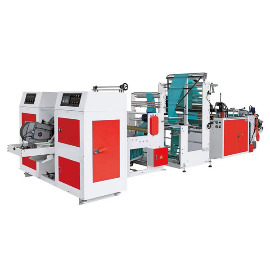
Plastic Bag Making Machine
Key technical specifications for three-side sealing bag making machines include pouch width (30-400 mm), pouch length (50-600 mm), seal width (2-10 mm per side), film thickness (15-120 microns), and production speed (100-250 BPM). Sealing temperature ranges from 100-220°C, with independent controls for each sealing bar to accommodate different film properties on the seal edges. The sealing pressure is typically 3-6 bar pneumatic. The machine's power consumption is 10-30 kW, depending on the number of heating zones and servo motors. The cutting mechanism can be a rotary knife or a guillotine, with the rotary preferred for higher speeds. Many machines feature a film folding station for bags made from a single web, and an optional gusset former for stand-up pouch versions. Advanced models include a leak tester that automatically rejects pouches with weak seals, and a date coder for printing expiration dates on each pouch.
three-side sealing bag making machines are predominantly used in the food industry for single-serve sachets of ketchup, mustard, mayonnaise, coffee creamers, sugar, and salt. They also produce sample-size packets for cosmetics, shampoo, and lotion. In the pharmaceutical sector, they manufacture unit-dose sachets for powders, granules, and liquid medications, with strict requirements for seal integrity and barrier properties. The healthcare industry uses them for sterile swab packs and wound dressing pouches. Industrial applications include small hardware parts and chemical samples. The rise of e-commerce has also seen three-side sealing machines used for poly mailer bags that are sealed on three sides with a flap opening. With the growing demand for sustainable packaging, these machines are now equipped to process bio-based films, though the three-seal design requires precise temperature control to avoid blistering or burn-through on the multiple seal lines.
Selecting a three-side sealing bag making machine involves determining the pouch size, seal pattern, and required speed. If you need a simple pillow pouch, a machine with a single folding station and two side sealers is sufficient. For sachets with a bottom gusset (stand-up feature), you will need a machine with a gusset former and an additional bottom sealing station. Evaluate the seal width – wider seals provide greater strength but require more heating power. Check the machine's ability to handle the film material; metallized or laminated films may require longer dwell times or higher temperatures. For high-speed operations, choose a servo-driven model with a touchscreen HMI that stores multiple recipes for different pouch sizes, enabling changeovers under 10 minutes. Consider the integration with a filling machine if you plan to use the pouches for form-fill-seal applications. Also, verify the stacking system's capacity – for small sachets, a high-speed conveyor with a counter is essential to prevent jamming.
Maintenance of a three-side sealing bag making machine focuses on the multiple sealing bars. Each seal bar must be cleaned daily to remove residual film, as residue can cause seal defects. Check the temperature sensors on each bar weekly to ensure uniformity, as temperature variations between the three bars can lead to inconsistent seal strength. Lubricate the folding station and guide rollers regularly to prevent film scratching. The cutting blade should be inspected monthly and replaced if dull. For machines with a leak tester, calibrate it weekly using standard samples. The registration system requires periodic cleaning of the camera lens and alignment verification. Since three-side machines often handle thin films, the film tension must be carefully monitored; use a tension gauge to set the dancer arm correctly. Keep spare heating elements and thermocouples for each sealing bar, as these are the most commonly replaced components. By maintaining each seal station meticulously, operators can ensure that every pouch meets quality standards, reducing waste and rework in high-volume production environments.