vest bag making machine
A vest bag making machine is a specialized bag production system that produces bags with die-cut handles and often includes a gusset-forming section, resulting in a bag that resembles a vest with armholes when opened. Unlike T-shirt bags that have simple cut-out handles, vest bags have reinforced handle areas created by die-cutting, which provides greater strength and a more comfortable grip. The gusset feature allows the bag to expand, offering a larger volume capacity, making vest bags ideal for heavier groceries, hardware items, and bulk goods. Vest bag making machines are commonly used in supermarkets, department stores, and specialty retail where customers carry multiple or heavy items. These machines are more complex than T-shirt bag machines, requiring additional forming plates and a die-cutting station, and typically operate at speeds of 80-150 bags per minute.
The working process of a vest bag making machine involves several distinct stages beyond the basic bag making sequence. The film from the unwind roll enters a gusset-forming section where folding boards and forming triangles create side gussets – folds that allow the bag to expand when filled. The gusseted film then proceeds to the bottom sealing station to create the bottom seal. Next, the film moves to the die-cutting station, where a rotary or flat-bed die cuts the handle shape (usually a U-shaped or oval opening) out of the top portion of the bag, leaving the handle intact on both sides. This die-cutting action is more robust than simple punching, as it cuts through multiple layers including the gusset folds. After die-cutting, the film is separated into individual bags by a cutting knife. A unique feature of vest bag machines is the handle sealing – some machines apply an additional seal around the handle cut to reinforce it and prevent tearing. The finished bags are stacked on a special gusseted-bag stacker that accommodates the expanded shape.
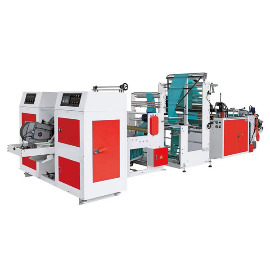
Plastic Bag Making Machine
Key technical specifications for vest bag making machines include maximum bag width (300-800 mm), bag length (400-1000 mm), gusset depth (up to 150 mm), film thickness (20-80 microns for PE, up to 100 microns for recycled blends), and production speed (80-150 BPM). The die-cutting unit requires a high-pressure system (pneumatic or hydraulic) with force ratings from 5 to 20 tons, depending on handle size and film thickness. Sealing temperature ranges from 130-220°C, with separate zones for bottom seal and handle reinforcement. The machine's electrical power is typically 20-40 kW, and compressed air requirement is 6-8 bar at 500-1000 L/min. The stacking system must handle gusseted bags that do not lie completely flat; many machines use a tucking mechanism to flatten the gusset for stacking. Optional features include a handle reinforcing tape applicator for extra strength, automatic roll splicer, and in-line printing for branding.
vest bag making machines are widely used in grocery stores for carrying produce, canned goods, and beverages. The gusset allows the bag to hold more volume, making them preferred for customer purchases of multiple items. Department stores and clothing retailers also use vest bags for apparel and accessories, as the die-cut handles are more comfortable for hand carrying. In the food service industry, vest bags are used for take-out and delivery orders, especially for heavier containers. Industrial and hardware stores use them for small parts and tool packaging. With the increase in online grocery delivery, vest bags are also used as secondary packaging for delivering orders to customers' doors. The trend towards sustainable materials has led to vest bag machines being adapted to process compostable films and post-consumer recycled content, requiring precise control of die-cutting pressure and sealing temperature to avoid material fracture.
Selecting a vest bag making machine requires careful consideration of the gusset depth and handle design. The gusset depth should match the intended load – larger gussets for bulkier items. The die-cutting station must be capable of producing the desired handle shape, and the die can be customized (e.g., round, oval, or ergonomic). Evaluate the machine's ability to handle the film thickness you plan to use; thicker films require higher die-cutting force and longer dwell times, which may reduce speed. If you need reinforced handles, look for a machine with an integrated tape applicator. Consider the stacking system – if you require high stacks (200+ bags), ensure the stacker has a compression mechanism to flatten the gusset. Check the changeover time between different bag sizes, as quick change dies and adjustable gusset formers reduce downtime. Also, inspect the construction quality of the die-cutting cylinder, as it undergoes high stress and must be precision-balanced to avoid vibration at high speeds.
Maintenance of a vest bag making machine is more demanding due to the die-cutting unit and gusset formers. The die-cutting knives must be kept sharp – dull dies cause ragged cuts and handle tearing. Inspect the die surface daily for wear and replace or sharpen it every 1-2 million cycles. Lubricate the die-cutting cylinder bearings weekly. The gusset forming plates must be kept clean and free of scratches that could cause film scratching or sticking. Regularly check the alignment of the gusset formers with the film path; misalignment leads to asymmetrical gussets. The handle reinforcement seal station (if present) requires the same cleaning and temperature calibration as the main sealing bars. Also, clean the film guide rollers to prevent dust buildup that could affect gusset folding. Since vest bag machines operate at lower speeds, thermal stresses are less intense, but the mechanical wear from die-cutting is significant. Maintain a stock of spare dies and handle-forming components to minimize downtime. By prioritizing the die-cutting unit and gusset section, operators can ensure consistent bag quality and strength, meeting the expectations of retailers and end-users.